Saturday, April 19, 2014

Decorate Easter Eggs

Easter egg decoration is a tradition for a very long time. The symbol of the egg is rooted in a pagan springtime fertility feast. The Christians have adopted the egg as an Easter symbol that represents new life. In many areas of the world, people color and decorate eggs as part of their Easter celebrations. It became such an important tradition in some part of the world so in the city of Kolomyia, in the Ukraine they have a museum with over ten-thousand decorated eggs. 
Many Slavic ethnic groups  decorate eggs for Easter. While decorated eggs of various Slavic nations have much in common, national traditions vary.
Many of the names derive from the Slavic root pisa which relates to painting (and cognate with Latin pictura). In Slavic tradition, the egg is written, not drawn or painted. This is a Central and Eastern European and not strictly Slavic tradition, since non-Slavic ethnic groups in the area also practice In Bulgaria, widespread tradition is to fight with eggs by pair and one's egg become last surviving is called „borak” (fighter).
In Germany, decorated eggs are hung on branches of bushes and trees to make them Easter egg trees. Eggs also used to dress wells for Easter.


In Hungary, Lithuania and parts of Romania people use another technique for Easter eggs. A pattern is applied to an egg by the process of wax-resist, similar to batik. A stylus (a writing or making shapes utensil, maybe a feather) is used to apply hot wax to the shell of an egg, which is placed in a series of dye baths. The wax seals the dye into the egg; the colours and pattern are revealed when the wax is  melting and removed at the end.


Other techniques include "scratch" technique, where dye is applied to an egg and then patterns scratched onto the shell; painted eggs, where the shells are painted using a brush; and various versions of appliqué, where items (straw, paper, beads, sequins) are glued to the shell of an egg.


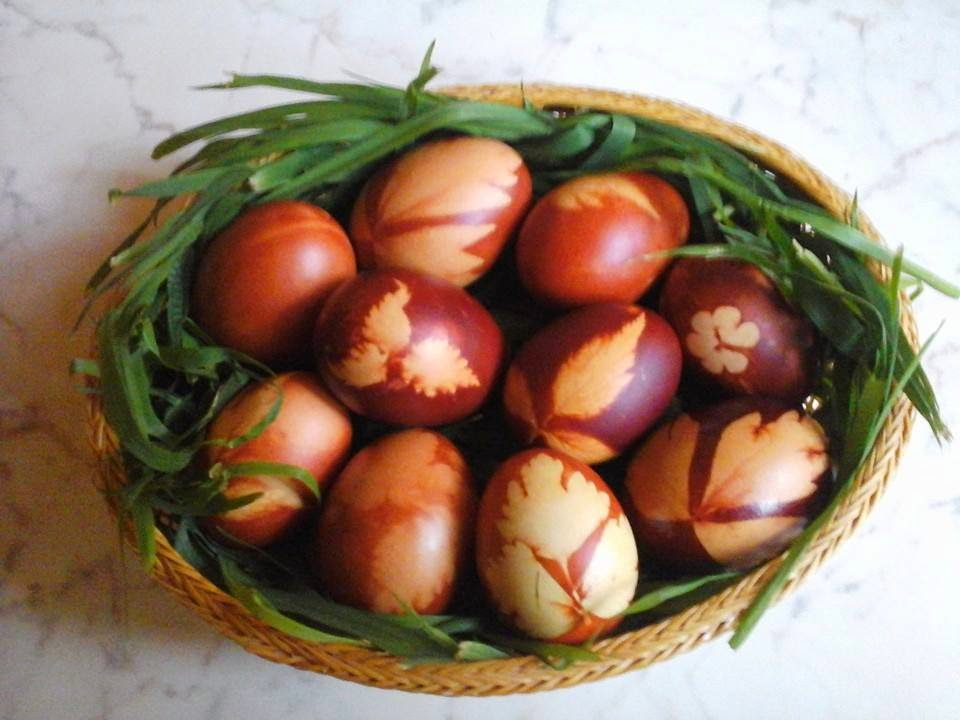
I use an old-fashioned natural method: I put some little leaves on the eggs, wrap them in pieces of old tights and boil them together with red onions skins. 


                                            HAPPY EASTER TO ALL OF YOU!

Easter Table in Greece

The celebration of Orthodox Easter (Pascha) is considered the most important holiday on the Greek calendar. Special traditions mark not only the mourning of Christ’s Crucifixion and the celebration of Resurrection, but also the passage from winter to spring.
The word "Pascha" derives from the Jewish "Pasah" which means "Passover". Jewish people celebrated "Pasah" to commemorate their liberation from the Egyptians and the passage of the Red sea.
The traditional services and customs of Orthodox Easter are inevitably linked with both fasting and festive foods. When the Christians began to celebrate Easter, they retained some of the features of the Jewish Passover, such as eating lamb. In Byzantine times, it was the custom to bake ring-bread with a dyed red egg in the middle. The egg is a symbol of life, while red is the color of life.
During Holy Week complete fasting is to take place. Palm Sunday, which is the first day of the Holy Week, is a day when only fish and fish courses are served. On Good Friday, sweet things are not eaten - for the love of Christ, who was given vinegar to drink. Soup made with sesame-paste, lettuce or lentils with vinegar is the food eaten on this day.


On Easter Sunday celebration begins early in the morning with the cracking of red eggs ("tsougrisma") and an outdoor feast of roast lamb followed by dancing. Before the eggs are eaten, people rap their eggs against their friends' eggs and the owner of the last uncracked egg is considered lucky. It's a game enjoyed by children and adults alike. Eggs are often made in very large quantities since the game continues on the next day with more friends and family.


Following 40 days of fasting, the traditional Pascha meal is a banquet of meat, eggs and other long - forbidden animal products. Cheese, eggs, and richly scented breads play an important part on the table, but the meal is always centered around meat. The Easter table reflects the culinary differences around Greece.
The main attraction of the day is whole roasted lamb or goat (kid) to represent the Lamb of God, however many prefer oven and stovetop lamb or kid dishes. Spit-roast lamb is the prevalent tradition, but many areas preserve their distinctive way of preparing the Easter dish. On many islands (Andros, Samos, Naxos, Rhodes) lamb is stuffed with rice and herbs, then baked in the oven.
Magiritsa, a Greek soup made from lamb offal, is eaten to break the fast of the Greek Orthodox Great Lent. In its traditional form, magiritsa simply consists of all the offal removed from the lamb before roasting, and subsequently flavored with seasonings and sauces. Prepared by Greeks on Holy Saturday along with the next day's lamb, magiritsa is consumed immediately after the Pascha midnight Divine Liturgy. The dish is particularly thick and filling, making it a satisfying meal for breaking the fast.
There are many other delicacies included in the Paschal feast: cheese pittes, regional fresh cheeses and yogurt served with honey.
The sweets include special tsoureki and the koulouria tis Lambris (biscotti di Creta).
Great Greek wines, ouzo, and other drinks flow freely, and preparations for the meal turn into festive celebrations even before the eating begins.

These high-spirited gatherings often last long into the night.

Wednesday, April 16, 2014

Hippo in Verona

“Ippopotamo” is a nice restaurant in Piazza Bra, 1 minute from the Verona Arena. Great location, good food, competent and friendly staff speaking different languages (English, Russian, German, Romanian). It is situated near the city´s main shopping streets and a bus station and taxi rank. If arriving by car, you can unload luggage just 10 metres away before parking in one of the car parking no more than 200 metres away. 


We enjoyed our food and our drinks on the terrace, overlooking the Arena and the Piazza Bra, people walking and taking pictures. It was a lovely spring day. It was nice we received some paper crowns, the map of Verona on the back.


The menu is huge and it has enough options, especially Italian dishes and many desserts. Burgers, chicken strips, curly fries, pastas, caprese salad, barbeque ribs, gnocchi with red meat sauce, pizzas, fish dishes, sandwiches are some of the dises one can choose. Not to mention gelato (icecream)! The prices were reasonable but it was good we received a card for 10% off the bill at the end.


In the center of the table there was a good selection of olive oils, vinegar and herbs. 


The pizza we ate (Rustica and Ippopotamo) was very filling and delicious. 
Pizza is an oven-baked flat bread typically topped with a tomato sauce, cheese and various toppings. The modern pizza was invented in Naples, Italy, and the dish has since become popular in many parts of the world. Pizza is cooked in various types of ovens, and a diverse variety of ingredients and toppings are utilized. An establishment that makes and sells pizzas is called a "pizzeria".
The largest pizza was made in JohannesburgSouth Africa, on December 8, 1990. According to the "Guinness Book of Records" the pizza was 37.4 meters in diameter and was made using 500 kg of flour, 800 kg of cheese and 900 kg of tomato puree.
The most expensive pizza was made by the restaurateur Domenico Crolla, and included toppings such as sunblush-tomato sauce, Scottish smoked salmon, medallions of venisonedible goldlobster marinated in the finest cognac and champagne-soaked caviar. The pizza was auctioned for charity, raising £2,150.


The atmosphere is friendly and they have a children´s play area. A great place to relax.
The name of the locanda come from the hippopotamus (Hippopotamus amphibius) or hippo, from the ancient Greek for "river horse". It is a large, mostly, herbivorous mammal in sub-Saharan Africa, the third-largest type of land mammal after the elephant and rhinoceros


I recommend this restaurant to all visitors of Verona, even family with kids.

Tuesday, March 11, 2014

Gibraltarian cuisine


Gibraltarian cuisine is a mix of Mediterranean (Spanish, Italian, Maltese) and British cuisine.
I visited Gibraltar just for one day after spending ten days in Spain. Everything around looks like British so I prefered to eat in a pub, on the terrace, in front of The Governor House. Of course, I enjoyed some fish and chips and a glass of beer.
Fish and chips is an English dishconsisting of battered fishcommonly cod or haddock, and deep-fried chips. It is a common take-away food.


Fish and chips became a stock meal among the working classes in the United Kingdom during the second half of the 19th century due to the development of trawl fishing and of railways which connected the ports of the North Sea to major industrial cities, which meant that fresh fish could be rapidly transported to the heavily populated areas.
Deep-fried fish was first introduced into Britain during the 16th century by Jewish refugees from Portugal and Spain. Deep-fried chips may have first appeared in Britain in about the middle of 19th century. Charles Dickens mentioned chips in "A Tale of Two Cities" (published in 1859): "Husky chips of potatoes, fried with some reluctant drops of oil". During World War II fish and chips remained one of the few foods in the United Kingdom not subject to rationing.
The first fish and chip shop was opened in London in 1860. Early fish-and-chip shops had only basic facilities. Usually these consisted principally of a large cauldron of cooking fat, heated by a coal fire.
The modern fish-and-chip shop sell fish with the particular species named; so "cod and chips" now appears on menus rather than the more vague "fish and chips".
Unfortunatelly, I had no time to taste some typical dishes, as I like to do everytime I visit a new place.
Examples of Gibraltarian cuisine:
Calentita, Gibraltar's national dish is a baked pancake-like dish made with chickpea flour, water, olive oil, salt and pepper. The word calentita is the informal diminutive of the Spanish word caliente, and means "nice and warm (or hot)". Calentita goes back to the 16th century. The name may have come from street vendors who would shout "Calentita" to sell their freshly-cooked wares. It has been suggested that the origin of the calentita is in the food culture of Sephardi Jews from the Barbary Coast. 


Rosto, a pasta dish of Italian origin consisting of penne in a tomato sauce with beef or pork, mushrooms and carrots (or other vegetables) and topped with grated "queso bola" (Edam cheese).


Fideos al horno (baked noodles in Spanish), a baked pasta dish consisting of macaroni, bolognese sauce, and various other ingredients including egg and bacon, usually topped with a grated cheese or béchamel that melts during the baking process and aids in binding.


Panissa, a bread-like dish similar to the calentita. Sharing its Italian origins, it is a descendant of the Genoese dish with the same name. Unlike calentita the ingredients are first cooked in a pan to form a paste which is then left to set. When the polenta-like dough is set, it is cut into small strips and fried in olive oil.


Bollo de hornasso, a sweet and dry bread similar to the Spanish hornazo. It is made with self-raising flour, sugar, eggs, butter or margarine and aniseed. Bollos de hornasso are eaten around Easter just as in Spain, but in Gibraltar they are also popular during Christmas. Gibraltarian hornassos can normally be distinguished from the original Spanish hornazo as they do not tend to be decorated with hard-boiled eggs (however, Gibraltarian families of Spanish descent may still decorate them in this manner). It is usually glazed with beaten eggs.


Japonesa (English: Japanese lady) is a sweet fried doughnut filled with a custard-like cream. Japonesas are usually enjoyed at teatime or as a snack. They are traditionally coated in syrup or granulated sugar. The origin of its name is unknown but resembles the Japanese dorayaki.